


Contributors: Jack Freeland
Date published: 17 July 2026
Download as PDFFIFA World Cup 2026: Can English and Scottish clubs sign the tournament’s breakout stars?
With its expanded format and a record 48 participating nations, the FIFA World Cup 2026 is the largest in the competition’s history. With 1,248 players on show, clubs and fans alike have spent the past month watching emerging talent and potential transfer targets. As the tournament reaches its final weekend, attention is turning to the summer transfer window.
However, a standout performance at the World Cup does not guarantee that a foreign player can sign for an English or Scottish club. Foreign nationals who do not already hold a visa that permits them to play professionally in the UK must apply for an International Sportsperson visa, and they can only apply if they meet certain criteria.
International Sportsperson visa
To apply for an International Sportsperson visa, a player must first receive Governing Body Endorsement (GBE) from either the Football Association (FA) in England or the Scottish Football Association (SFA) in Scotland. Once endorsed, the player can be sponsored by their club before applying for an International Sportsperson visa.
There are several routes to endorsement, and for clubs, understanding these regulatory pathways is just as important as identifying the talent itself.
The points-based route
The primary route to endorsement is through a points-based assessment. Players must generally achieve at least 15 points across a range of criteria, including international appearances; domestic and continental club appearances; and the performance of their club.
The points available are weighted according to the live FIFA ranking of national teams, and the FA’s and SFA’s banding of domestic leagues and continental competitions. These bandings are reviewed annually and are not always identical between England and Scotland.
Often, the international appearances criteria is the most significant, as elite players can achieve an ‘Auto Pass’ if they play enough minutes for a highly ranked nation. This grants endorsement without needing to accumulate points across the remaining categories.
The table below shows how this works for players. Each column represents the FIFA World Ranking of the player’s national team and each row represents the percentage of competitive international matches in which the player featured. The corresponding cell shows the outcome: an automatic endorsement, the number of points awarded towards the 15-point threshold, or no points. The stronger the nation, the fewer appearances needed to achieve an Auto Pass. For players representing nations ranked outside the top 50, an Auto Pass is not available.
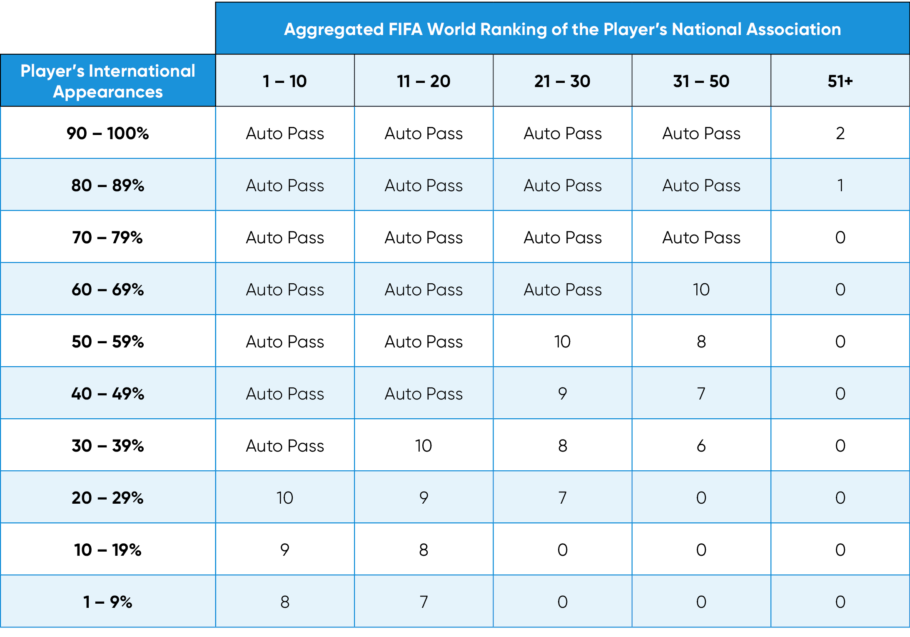
As you can see, not every elite player is eligible for an Auto Pass, regardless of talent.
Take Paris Saint-Germain’s Khvicha Kvaratskhelia, for example. Despite winning this year’s UEFA Champions League and being named the competition’s Player of the Season, since he represents 72nd ranked Georgia he could only generate a maximum of two points through international appearances.
To be eligible for endorsement, Kvaratskhelia would therefore need to rely on other criteria to accumulate the required 15 points. Though in practice, this would be straightforward as his club achievements comfortably take him beyond the 15-point threshold. Winning the French Ligue 1 earns six points as a Band 1 domestic league, while his success in the Champions League earns a further 10 points as a Band 1 continental competition.
While the system is designed to identify players competing at the highest levels of the game, it can present challenges for talented players representing lower-ranked nations or those playing in lower-banded leagues.
Exceptions Panel
Recognising that talented players do not always fit neatly within a points-based framework, both the FA and SFA operate an Exceptions Panel to which clubs can apply for a discretionary waiver of the standard criteria.
To be considered in England, a player must have scored between 10 and 14 points, with ‘exceptional circumstances’ preventing them from achieving the full 15.
In Scotland, by contrast, there is no minimum point threshold, meaning a wider range of players at this World Cup could be considered.
Both football associations can also consider youth players without a minimum points threshold requirement, when they are regarded as possessing substantial quality and potential.
Elite Significant Contribution players
A final recruitment pathway exists exclusively for English clubs through the Elite Significant Contribution (ESC) mechanism.
Premier League and Championship clubs may hold up to four ESC places for players (League One and Two clubs can hold up to two), with the precise allocation depending on the playing minutes each club gave to English-qualified players the previous season.
Although discretionary, this pathway does not rely on accumulating points and is comparatively more accessible. A player can qualify having made, for example, at least one competitive international appearance for a nation ranked in the FIFA top 50, or at least five for a nation ranked outside the top 50.
However, as of 15 June 2026, this route is only available to players born on or after 1 January 2003, effectively limiting eligibility to players under the age of 23. The timing is crucial. Before this change, almost any player featuring at the World Cup would have qualified through the ESC route. This is particularly relevant at a World Cup where many of the headlines are being made by older players reaching a new level. Now, regardless of how they perform at the tournament, players over the age of 23 can no longer rely on the ESC pathway.
Vozinha
Cape Verde goalkeeper Vozinha has been one of the unexpected standout performers of the World Cup, and a good example of how talent does not guarantee endorsement. Recently released by Portuguese second-tier team Chaves, he is now available as a free agent and looking for a new club.
Despite his World Cup performances, Vozinha’s appearances for 64th ranked Cape Verde and in Portugal’s second tier leave him well short of the points required for endorsement. The recent rule change also means he is too old to qualify as an ESC player.
The position differs in Scotland. Unlike the FA’s Exceptions Panel, the SFA has neither a minimum points threshold nor an age restriction. A Scottish club could therefore invite the panel to find that Vozinha’s performances and experience justified an exception. For certain World Cup players, that distinction between the English and Scottish systems may prove decisive.
The regulatory reality
For English and Scottish clubs, identifying talent at the World Cup is only part of the equation.
Some elite players will pass automatically or through the points-based system, others will depend on discretionary pathways, and some will have no route at all.
As the summer transfer window unfolds, recruitment opportunities will be shaped as much by immigration and regulatory requirements as by performances on the pitch.
This article was co-authored by Trainee Campbell Kershaw.
Contributors:

Jack Freeland
Associate
Further / related posts

17 March 2025
Contributor: Aine Coll

20 October 2023
Checking the Score on Pregnancy and Parental Rights in Sport
Contributor: Carly Duckett

2 July 2026
The Sporting Events Bill: A big win for business?
Contributor: Roddy Forgie
To find out more contact us here
Expertise: Employment, Employment and Immigration, Immigration
Sectors: Sport, Sport, Entertainment and Media